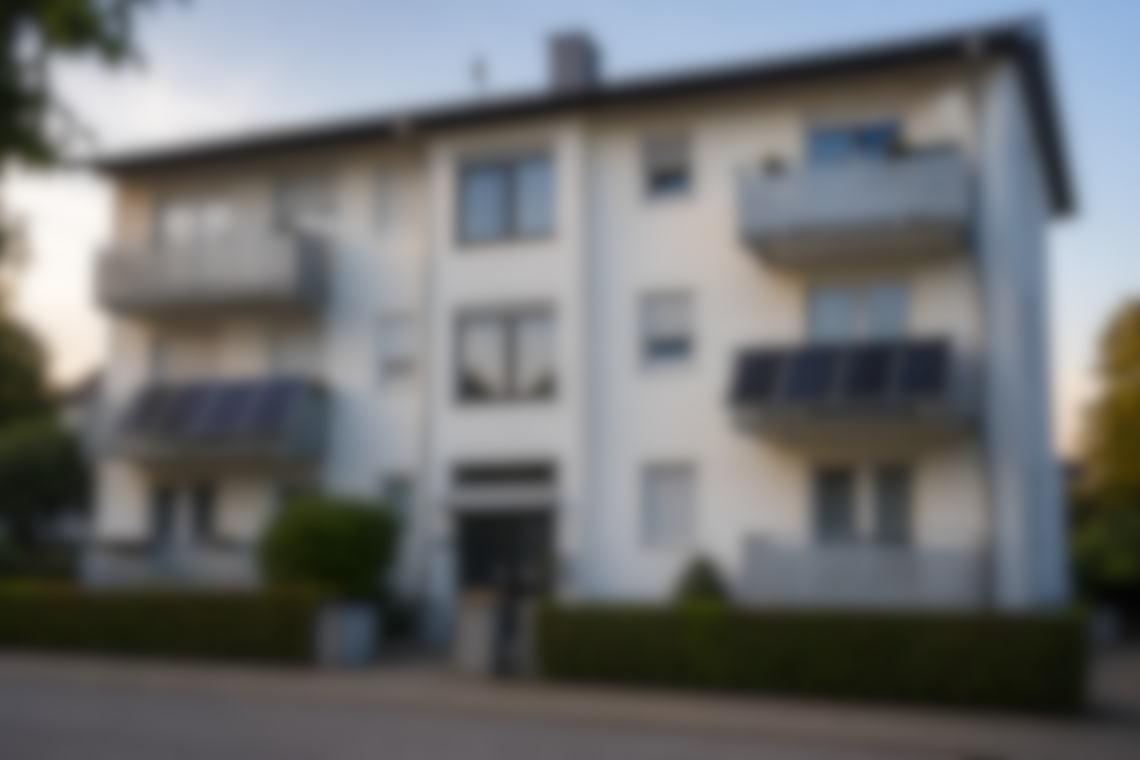
Balcony Solar Systems in Apartment Buildings
Background and Motivation
Back in 2025, I briefly touched on balcony solar systems in an article about home automation. Since then, a lot has happened and with 5 out of 8 Balcony Solar Systems installed we have gained quite a bit of practical experience that I would like to share. Not because the information cannot be found elsewhere, but because some of the things we learned were far from obvious to me. Since many different topics are involved, I decided to build upon the previous article and turn this into a series.
- Home Automation without the Cloud
- Balcony Solar Systems in Multi-Family Buildings (this article)
- Power Consumption and Load Profiles
- Battery Storage for Balcony Solar Systems
- Control Theory in Home Automation
- Making Information Visible
- From Balcony Solar Systems to a Local Energy Network
Anyone receiving a monthly electricity bill well into the triple digits will eventually start thinking about how to reduce power consumption. However, the focus was never on the really simple questions such as “Wouldn’t one less monitor do the trick?” or “Does the server really need to run around the clock?”. The question was rather how unnecessary consumption could be avoided without sacrificing comfort or existing habits.
This effort was by no means unsuccessful. From the obligatory switch from incandescent bulbs to energy-saving lamps and later LEDs, through replacing older hardware, all the way to retiring an HP Microserver N40L in favor of a much more efficient custom-built system based on an Intel i5-8600T, many consumers could be optimized.
Unfortunately, everyday life also changes. More and larger monitors, a new oven that gets used more frequently, or a monoblock air conditioner that feels as if 80% of the consumed energy disappears straight out of the window eventually lead to increasing electricity consumption.
The idea of compensating part of that consumption with solar panels has therefore been around for many years. Unlike some of the stories one occasionally hears about rather “creative” solutions, quietly mounting and connecting a few solar panels with an inverter was never an option for me.
The decisive push eventually came with the introduction of plug-in solar systems, making renewable energy accessible even to residents of multi-family buildings and tenants. The final trigger was the approval of inverters with a feed-in power of 800 W.
Taking Stock
Back in the days when solar panels were still expensive, one would often hear statements like “If your roof or balcony doesn’t face south, you might as well forget it.” Well, my apartment comes with not one but two balconies. Neither of them faces south. The smaller one points east – or rather east-southeast – while the larger one faces west, or more precisely west-northwest. It even contains the word “north”, which obviously sounds terrible. But panel prices had come down, so why not continue?
The next step involved a folding ruler and measuring all five sides of both balconies. While the three shorter sections were too small for any standard-sized modules, the front of the larger balcony could at least accommodate two 500 W panels. Facing west-northwest and partially shaded by a tree at certain times of the day. The balcony later nicknamed “rear” seemed destined to receive its solar panels more for decorative purposes than for actual power generation.
Now for the “front” balcony. Its railing turned out to be just a little too short, even for two 450 W panels. Fortunately, the balcony protrudes freely from the building, so a slight overhang would hardly bother anyone. And the price of a 2×450 W system was quite reasonable, so why not give it a try?
Neither balcony even had a functioning outdoor power outlet. In other words, the conditions could hardly have been worse for installing balcony solar systems. Fortunately, the landlord liked the idea.
The Legal Situation
Almost every article I found and read on the subject pointed out that approval from the property owner would be required and that this approval could only be denied for serious reasons. Fair enough. However, not a single one of these articles even mentioned the special circumstances of a co-owners’ association. One might argue that this should have been obvious. For us, it wasn’t.
Before diving into modules, inverters and battery storage, it is therefore worth taking a brief look at the legal framework and at a few things nobody bothered to tell us beforehand.
Installing a balcony solar system generally constitutes a structural modification of the common property. This remains true even if the building itself is left untouched and the panels are merely attached to the balcony railing. The decisive factor is the permanent change to the external appearance of the building. Since October 2024, however, plug-in solar systems have been treated as privileged structural modifications under the German Condominium Act (WEG). This means that the co-owners’ association is generally required to grant approval. A complete ban is only possible in exceptional cases, for example due to safety concerns or special structural requirements.
One important detail is often mentioned only in passing: the legal entitlement does not replace a formal resolution by the co-owners’ meeting. Even though approval must usually be granted, the formal process should still be followed. Installing a system without prior approval may become problematic despite the legal entitlement. The Federal Court of Justice reaffirmed this in 2025.
In our particular case, this meant that besides coordinating with the owner, an official resolution of the co-owners’ association had to be prepared and submitted.
Looking back, it would have been helpful if the various guides had mentioned this point (at all). We simply installed the systems first and potentially wasted quite a bit of goodwill in the process.
Arguments and Reality
The legal framework is one thing. Reality inside a co-owners’ association is often something entirely different. Not every discussion is based solely on technical facts. Besides legitimate questions, there is often emotional resistance to change, which can manifest itself in many different ways. This observation probably applies not only to balcony solar systems but to co-owners’ meetings in general.
These experiences may well have been one of the reasons why plug-in solar systems were added to the catalog of privileged measures through the Solarpaket I and why §20 paragraph 2 WEG was amended accordingly. The basic admissibility of such systems should no longer depend on the personal preferences of individual owners.
One particularly helpful source for us was Bundestag document 20/12146. It explicitly states that plug-in solar systems should generally be made possible and that their implementation should not be unnecessarily hindered. Co-owners’ associations may regulate how such systems are implemented, but they should not prevent their use without good reason.
The legal limit is reached when another owner suffers disadvantages exceeding what is unavoidable in an orderly coexistence. This follows from §14 paragraph 1 number 2 WEG. In our case, this meant:
- no relevant shading of neighboring areas,
- professional installation using approved mounting systems and additional safety measures,
- no restrictions regarding the use of common or private property.
From our perspective, no unreasonable disadvantages for other owners were to be expected. Usage itself is regulated by §19 paragraph 1 WEG, while the structural aspects are covered by §20 paragraph 1 WEG, §20 paragraph 2 sentence 1 number 5 WEG and §20 paragraph 3 WEG.
The following sources proved particularly helpful for us:
- §14 WEG – Obligations of Apartment Owners
- §19 WEG – Co-Owners’ Association and Decision-Making Authority
- §20 WEG – Structural Modifications and Plug-In Solar Systems
- Bundestag Document 20/12146 – Legislative Motivation
- Federal Court of Justice, Judgment of 18 July 2025 – V ZR 29/24 (mentioned only in passing)
The systems had already been installed when we finally realized that approval by the co-owners’ association would also be required. Looking back, doing things in the opposite order would certainly have been more elegant.
Fortunately, the overall reaction turned out to be much calmer than initially expected.
At least for the most part.
Numerous concerns and questions were raised. Apart from aesthetic objections, one person claimed that the system generated audible noise. This was somewhat remarkable considering that both panels and inverters were installed directly next to a bedroom and had never produced any unusual sounds, even at night. During the meeting, it was therefore stated that the system operates silently under normal conditions.
Interestingly, that was not the only point. Throughout the discussion, further accusations and claims surfaced for which neither the meeting itself nor later investigations revealed any factual basis. Apparently, this too is part of everyday life in many co-owners’ associations.
At that point, there was only one thing to do: remain calm.
Rather than responding on the same level, it proved far more effective to remain factual, take concerns seriously and repeatedly refer to actual facts and the legal framework. Not every opinion can be changed, but many fears can be addressed.
An interesting observation emerged. The more specific the discussion became, the more factual it turned. Abstract statements such as
“Those things are ugly.”
suddenly turned into concrete questions:
- How are the panels mounted?
- How much power is planned?
- Will the system make noise?
- What happens during a storm?
- Who is liable in case of damage?
- Can the installation be removed later?
And all of these questions can be answered.
In the end, approval was granted unanimously.
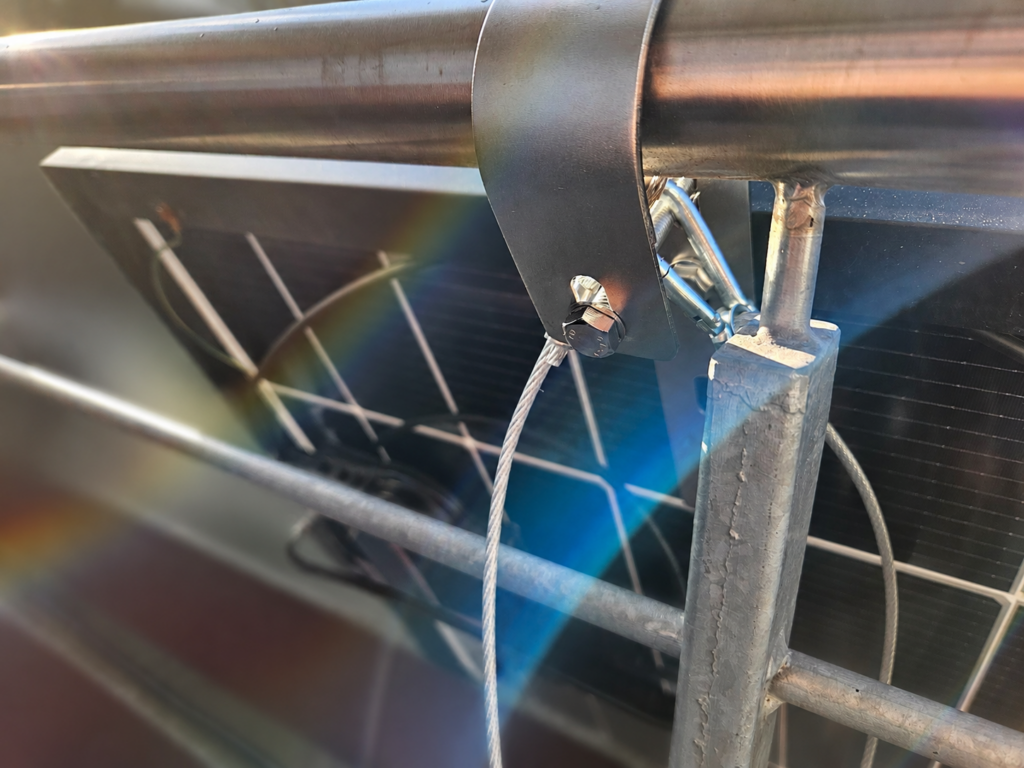
One detail turned out to be particularly interesting. Prior to the meeting, several compromises had been developed to make approval easier within the community. These included requirements intended to ensure a uniform appearance. For example, it had initially been suggested that front-facing installations should generally consist of two panels in order to preserve a consistent look. In hindsight, this seemed reasonable enough, especially since the systems that had already been installed followed exactly that pattern.
As the discussion progressed, however, attitudes changed noticeably. Once it became clear that plug-in solar systems had become legally privileged and that the question was no longer whether such systems would be allowed, but rather how they should be implemented, many of the original reservations disappeared surprisingly quickly.
One by one, the originally proposed restrictions were removed again. Suddenly, the prevailing opinion was that not every owner would necessarily require two panels and that no such requirement should therefore be imposed. Looking back, this may well have been the most interesting lesson of the entire discussion. The actual resistance seemed to be directed less against individual technical details and more against change itself.
Once this hurdle had been overcome and the basic admissibility of balcony solar systems was no longer in question, many issues that had previously been raised with considerable determination became surprisingly unimportant. This, too, is probably a lesson that extends far beyond balcony solar systems.
Planning and Installation
With the formalities out of the way, actual planning could finally begin.
At least in theory. As it turned out, the building itself seemed to have conspired against the use of standard-sized solar panels.
While the “rear” balcony offered enough space for two modules without any issues, the “front” balcony turned out to be considerably more challenging. Its front section was just slightly too short. Not by much, but enough to technically rule out the installation of two standard 450 W panels. Fortunately, the balcony protrudes from the building, so a small overhang would not bother anyone. The decision therefore favored two panels and symmetry over a technically cleaner but less powerful solution involving a single panel awkwardly placed somewhere in the middle.
Things did not become easier from there. The mounting hooks fit between the side railings with virtually no room to spare. By “virtually no room”, I really mean no room at all. The outer hooks touch the side elements of the railing and the two panels meet tightly in the middle. There simply was no additional space available.
Another surprise awaited underneath the balcony railing. The panels themselves provide four mounting points, while the railing offered only three supporting elements. Two were located near the outer edges and one exactly in the center. Direct mounting was therefore impossible.
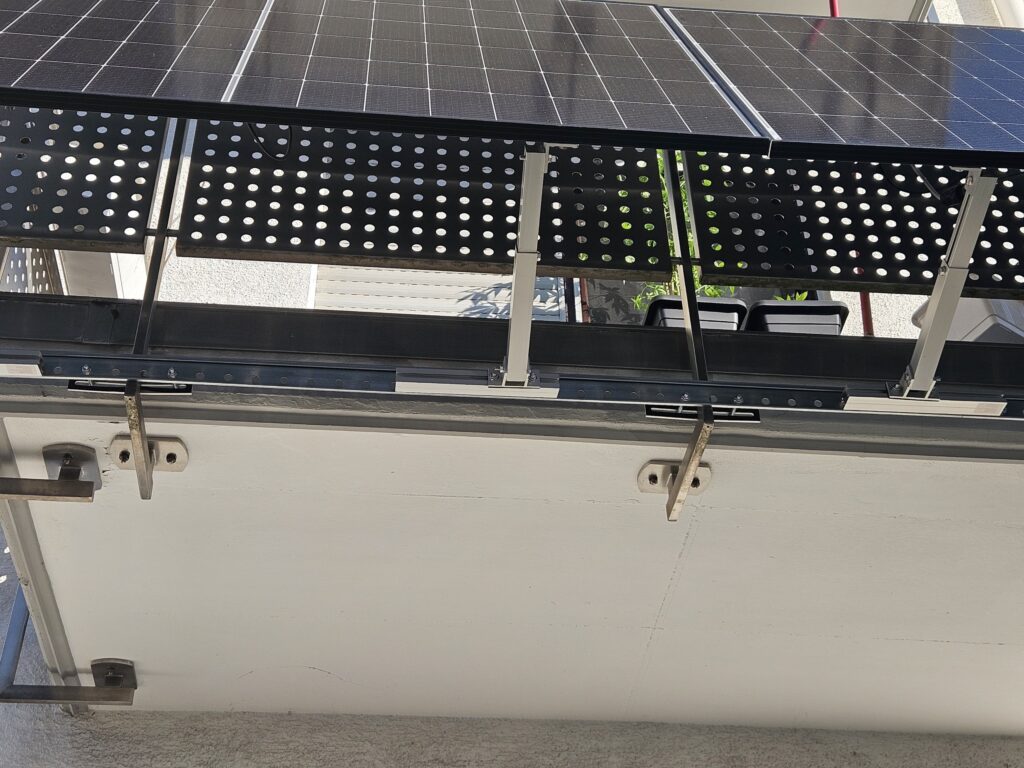
It quickly became clear that some kind of rail would be needed. Unfortunately, sturdy, inexpensive steel rails measuring three meters in length are not exactly available around every corner. Coincidentally, I had renovated my kitchen only a few months earlier and still had the remains of an IKEA METOD mounting rail lying around on one of the balconies – slightly more than one meter long. At roughly twenty euros for a two-meter rail and with an IKEA store nearby, the idea was born rather quickly.
After a brief encounter with a Dremel, one and a half METOD rails became the connection between the three support points of the railing and the four mounting points of the panels. Conveniently, the joint between both rails ended up exactly underneath one of the panel mounts. As a result, the same bolt that secures the panel to the railing also helps connect the two rails. Richard Dean Anderson would probably be proud of me.
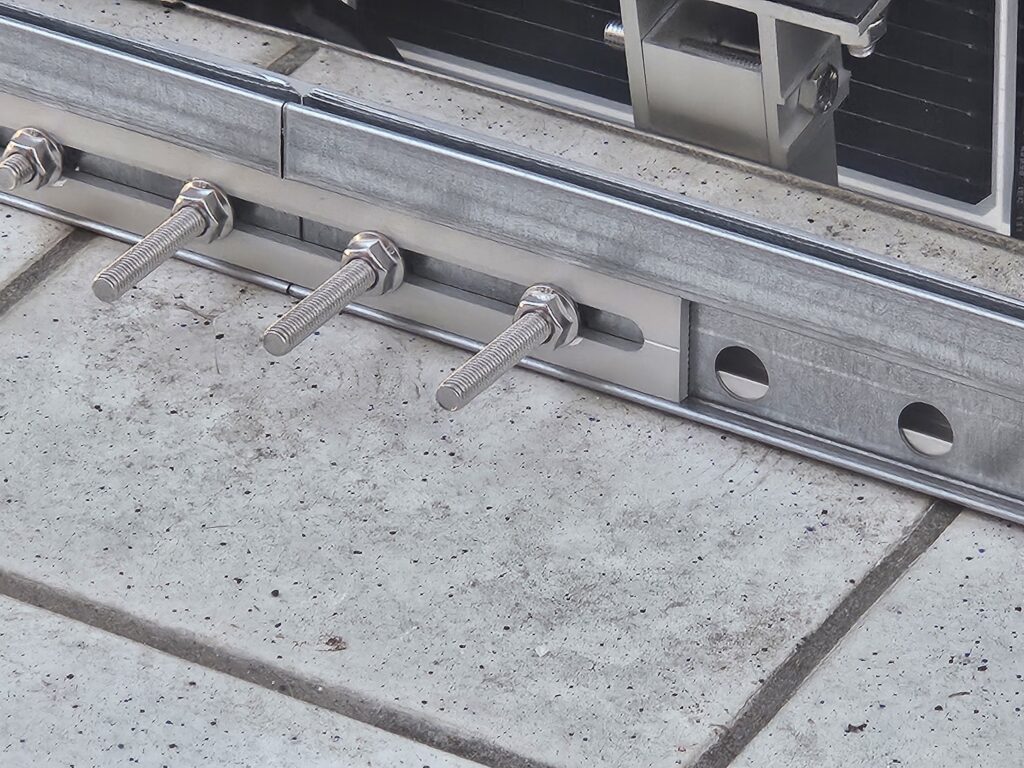
As improvised as the construction may appear at first glance, it distributes the load evenly, is mechanically stable and has performed flawlessly so far. At the request of concerned neighbors, additional safety cables were added, ensuring that even in the unlikely event of a failure the panels would not come crashing down.
Interestingly enough, the mechanical installation proved to be far more complicated and time-consuming than the electrical side of things. It is actually rather difficult to make serious mistakes when connecting cables and inverters. The connectors are practically foolproof. Granted, one should connect the cables in pairs, but that is hardly rocket science.
The real challenge was adapting standard components to a balcony that had obviously never been designed with solar panels in mind.
Looking back, however, I would no longer mount the inverter directly to the panels. As it turned out, it would later have to move.
First Experiences
After months of research, discussions and mechanical improvisation, commissioning ultimately consisted of plugging a power cord into a socket. And indeed: electricity flowed.
After all the legal questions, mounting considerations and improvised solutions, the whole process felt almost anticlimactic. The inverters quietly did their job, the electricity meter slowed down ever so slightly and the panels behaved exactly as expected.
Or rather: almost. As it turned out, some of the assumptions made at the beginning were simply wrong. The “rear” balcony, in particular, had originally been considered more of a decorative feature. West-northwest orientation, partial shading and even the word “north” in the description hardly inspired confidence. For years, people had insisted that anything not facing south would be economically pointless.
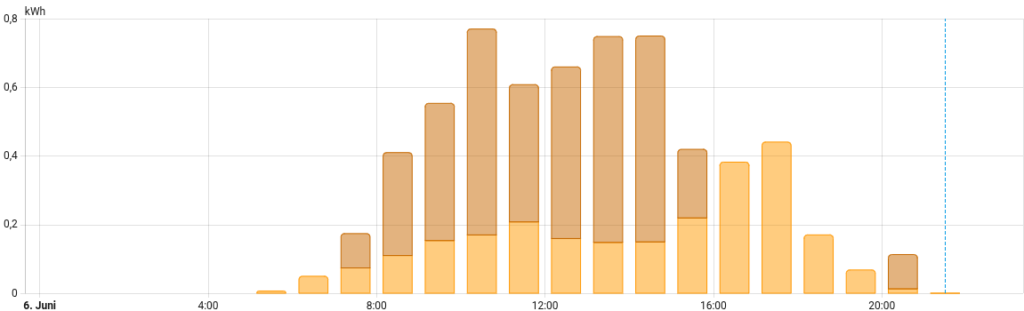
Reality proved otherwise. Of course, the “rear” balcony does not achieve the same yields as the “front” balcony. On good days, however, it still reaches around 600 W and contributes significantly to the overall production. Even more interesting are the less-than-perfect days. During rain or heavy cloud cover, the output frequently remains between 50 and 100 W. That still corresponds to roughly one-third to two-thirds of the permanent base load.
In my case, the base load sits at around 150 W. Routers, refrigerators, servers, chargers and numerous other small consumers ensure that electricity is needed around the clock. Over the course of a day, this translates into approximately 3.6 kWh and roughly 1,300 kWh over an entire year. Even small streams make a mighty river.
Exactly when the more expensive “rear” installation will have paid for itself remains somewhat unclear. Nevertheless, it turned out to be far more useful than originally expected. Perhaps not for spectacular peak production, but for something far more important: covering the base load.
And that is where the true strength of balcony solar systems lies. Not every ray of sunshine has to power the oven or the air conditioner. Sometimes it is enough that routers, refrigerators and the rest of everyday digital life no longer have to rely entirely on the utility company.
Two Balconies, Two Inverters and Still Only 800 W
From the beginning, it was clear that each balcony would receive its own inverter. The balconies are far apart and running DC cables through half the apartment neither seemed elegant nor particularly sensible. Two balconies therefore inevitably meant two inverters and, technically speaking, two balcony solar systems.
The surprising part was that none of this changes the maximum feed-in limit.
What matters is not the number of modules or inverters, but the maximum feed-in power per meter. This remains limited to 800 W in total. At the same time, up to 2,000 W of panel capacity are permitted in order to reach the 800 W limit more often under less-than-ideal conditions.
In our case, approximately 900 W of panel capacity ended up on the “front” balcony and around 1,000 W on the “rear” balcony. Hardly an optimal distribution. Had the front balcony been just a little larger, all panels would probably have ended up there. Ultimately, available space dictated the design rather than some brilliant concept.
Registration with the grid operator led to an interesting exchange. Initially, the use of two inverters was questioned, since their combined maximum output exceeded the allowed 800 W. The solution turned out to be software-based power limiting. From the grid operator’s perspective, this constituted an adequate solution. Interestingly, the split did not have to be 400 W and 400 W. Other distributions were accepted as long as the combined limit of 800 W was respected.
The same setup exists twice in two neighboring apartments. The overall east-southeast and west-northwest arrangement is identical, but local conditions differ. One of the rear balconies suffers from partial shading caused by a tree, whereas the other one is affected much less. Consequently, different inverter limits proved to be appropriate. In one case, a 600 W / 200 W split made sense, while the other apartment settled on 500 W / 300 W. The objective was not equal distribution, but rather matching the expected yields of both balconies.
Interestingly, the idea of adjusting these limits dynamically depending on time of day, sunlight conditions or expected production did not encounter any fundamental objections during the correspondence with the grid operator. Nevertheless, this is something best discussed with one’s own utility company.
The east-west combination turned out to be surprisingly advantageous. Whereas south-facing systems tend to produce most of their energy around noon, production here is spread across a much larger part of the day. In the morning, the “front” balcony dominates, while the “rear” balcony gradually takes over during the afternoon. This does not lead to spectacular peaks, but it does provide a remarkably even energy profile.
How well this generation matches actual consumption is, however, another question entirely.
The sun rarely follows one’s power consumption.
A Few Days in Reverse
Interestingly, a traditional Ferraris meter was still installed for a few days. Faced with this unusual situation, it reacted rather reluctantly and, on sunny days, actually turned backwards – slowly and almost painfully so. The period was so short, however, that the resulting savings probably amounted to only a few cents.
Less than a week later, the already planned meter replacement took place and a modern bidirectional meter was installed. Whether the timing was pure coincidence or simply a particularly good sense of humor remains open to interpretation.
With the new meter, the perspective changed as well. Up until then, the key question had been whether the panels would produce meaningful amounts of electricity at all.
That question was answered surprisingly quickly.
Another question suddenly became far more interesting:
When is the electricity actually consumed?
Because as encouraging as the production graphs were, one problem remained. The sun rarely follows one’s power consumption. Routers, refrigerators and servers happily accept every watt they can get. Ovens, dishwashers and air conditioners, unfortunately, do not. And any electricity that is not consumed immediately simply disappears into the grid without further compensation.
That marked the beginning of an entirely new chapter.
It turned out that generating electricity would not be the real challenge after all.
Using it efficiently would.


You May Also Like
Power Consumption and Load Profiles

Big Data and the Cloud