Power Consumption and Load Profiles
Back in 2025, I briefly touched on balcony solar systems in an article about home automation. Since then, a lot has happened and with 5 out of 8 Balcony Solar Systems installed we have gained quite a bit of practical experience that I would like to share. Not because the information cannot be found elsewhere, but because some of the things we learned were far from obvious to me. Since many different topics are involved, I decided to build upon the previous article and turn this into a series.
- Home Automation without the Cloud
- Balcony Solar Systems in Multi-Family Buildings
- Power Consumption and Load Profiles (this article)
- Battery Storage for Balcony Solar Systems
- Control Theory in Home Automation
- Making Information Visible
- From Balcony Solar Systems to a Local Energy Network
Electricity Generation as a Starting Point
Solar systems have one decisive disadvantage: they only generate electricity when a minimum amount of light is available. Surprisingly, the sun does not adjust its schedule to the personal habits of its users.
The trick with solar systems is therefore simply to consume electricity when it is being produced.
Thank you for your attention. End of article.
Well, in practice things are not quite that simple. As Goethe famously wrote in his masterpiece “Faust, Part One”:
In the beginning there was the co-owners’ association.
Or something along those lines.
The seemingly endless discussions about the most absurd trivialities are then followed almost seamlessly by several hours of physical, but also surprisingly creative, work. Anyone interested in this part of the story may want to have a look at the previous article.
Apart from these minor details, implementation is refreshingly simple: plug it in and you’re done.
Generating electricity is remarkably uncomplicated. A little sunlight is all it takes, and suddenly the electricity meter spins a little more slowly (or the numbers on the display increase somewhat less quickly). The real challenge, however, lies in matching generation and consumption as closely as possible.
In fact, the opening sentence already describes the core problem. Solar modules prefer to produce electricity during the day. Many larger consumers, on the other hand, tend to do their work in the morning, in the evening, or precisely when nobody is at home. The washing machine usually runs after work, the oven is rarely needed at 11 a.m. — unless one is fortunate enough to work from home — and air conditioning systems are, by their very nature, remarkably uninterested in the current feed-in curve.
This is precisely where terms such as base load, load profiles, battery storage and home automation begin to appear. And this is also where the subject becomes considerably more interesting than discussing how many watts a solar panel might theoretically deliver under ideal conditions.
Base Load as a Reliable Partner
Why Talk About Base Load?
The natural enemy of a balcony solar system is electricity consumption at the wrong times. Its best friend, on the other hand, goes by the name of base load.
Base load does not sound particularly exciting at first. It simply refers to those devices that require electricity more or less around the clock. Routers, refrigerators, servers, chargers, televisions in standby mode and countless small appliances ensure that electricity consumption never really drops to zero. Predictable, reliable and almost boring. At least until one reaches for a calculator.
What Does Base Load Actually Cost?
In the previous article, I already mentioned that the base load in my case is around 150 W. At first glance, that does not sound like much. In reality, however, 150 W already correspond to 3.6 kWh per day or roughly 1,300 kWh per year.
This very reliability of the base load turns out to be a major advantage. While the demand for cooking, washing or cooling varies considerably and can only be influenced to a limited extent, the base load patiently and reliably waits for every single watt the solar modules are able to provide. It asks no questions, does not care about the time of day and certainly does not require complicated control algorithms.
One might even say that the base load is surprisingly cooperative.
Especially during the summer months, this turns out to be rather convenient. Between roughly 6 a.m. and 9 p.m., solar power is available almost continuously. Every kilowatt-hour consumed directly by the base load during this time does not have to be purchased from the grid for about €0.35. Even in winter, meaningful yields are often available between 9 a.m. and 6 p.m.
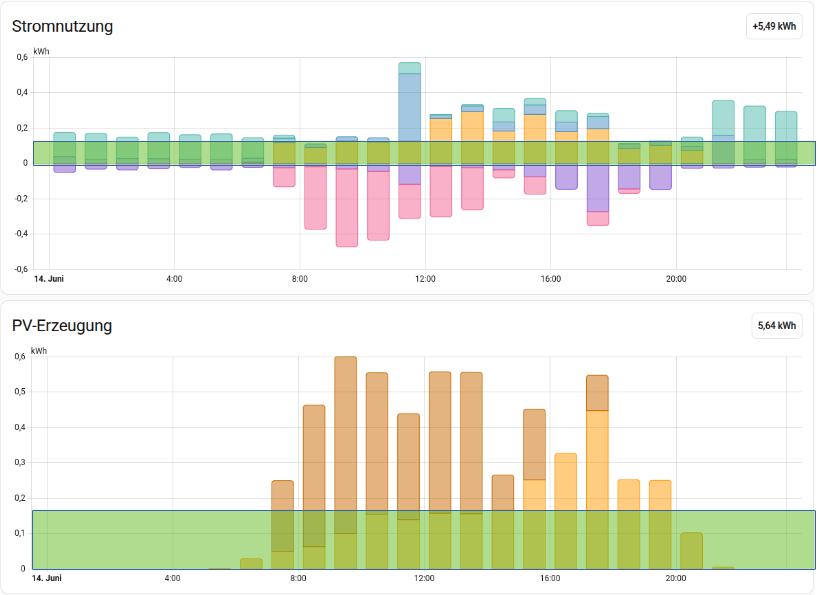
On average, this allows approximately 1.8 kWh per day or around 650 kWh per year to be absorbed directly by the base load. At an electricity price of €0.35 per kilowatt-hour, this corresponds to savings of roughly €230 per year. And all this without battery storage, Home Assistant or elaborate optimization strategies.
This is precisely why the rear balcony, originally intended more as a decorative feature, turned out to be far more useful than expected. Even on rainy days or under heavy cloud cover, the modules frequently still deliver between 50 and 100 W. That may not sound like much, but it already covers between one third and two thirds of the permanent base load.
As the German saying goes, every little bit helps.
From Base Load to Payback
The cost of the balcony solar system itself amounted to roughly €830, including shipping. Another €40 went into the IKEA METOD mounting rails, plus a handful of longer screws and various other bits and pieces. In total, this brought the investment to approximately €900.
Based on the base load alone, this would already result in a theoretical payback period of around four years. Larger consumers, battery storage and home automation are not even taken into account at this stage.
After just 3.9 years, the balcony solar systems will have paid for themselves — based on the base load alone.
This is, if anything, a rather conservative estimate. Shipping costs naturally become less significant when several systems are ordered together. The mounting structure also benefits from equipping multiple balconies at the same time. Each front balcony requires one and a half IKEA METOD rails, although they are only sold as complete units. Fortunately, two balconies require exactly three rails, allowing the material costs to be shared almost perfectly.
Almost as if somebody had actually thought this through.
The sad part is that there already was half a rail left over before the project even began. Since we intended to equip an even number of front balconies, the calculation worked out perfectly every single time. Two balconies require three rails, four balconies require six rails, and so on.
Even the single balcony in the neighboring building, which we will most likely help equip in the near future, does not require my half rail. Its railing has four supporting elements and therefore does not need this particular construction.
Ironically, the very half rail that inspired the current mounting solution is still lying around unused.
Looking at these rough numbers, the base load turns out to be the ideal customer for a balcony solar system. It is always at home, never complains and gratefully accepts every watt the sun happens to provide.
But of course, there is more to it than that.
What Are Load Profiles?
Looking at these rough figures, the base load turns out to be the ideal customer for a balcony solar system. It is always at home, never complains and gratefully accepts every watt the sun happens to provide. But of course, there is more to it than that, which brings us to load profiles.
A load profile is nothing more than the distribution of electricity consumption over time. Or, put differently, it answers the question of when and how much electricity is actually needed throughout the day.
At first glance, this may sound like a subject that only grid operators, power plant operators and people with far too much spare time — myself included — would find interesting. In practice, however, considerable savings can be achieved here. After all, the electricity consumption of many households is surprisingly poorly aligned with the production of solar energy.
Daily life tends to follow a fairly predictable pattern. People shower and have breakfast in the morning, spend much of the day away from home and then cook, wash dishes, do laundry or watch television in the evening. The pizza goes into the oven around 7 p.m., the dishwasher is loaded and started after dinner and the television ensures that a few (hundred) additional watts continue to flow through the wires until around 10:30 p.m.
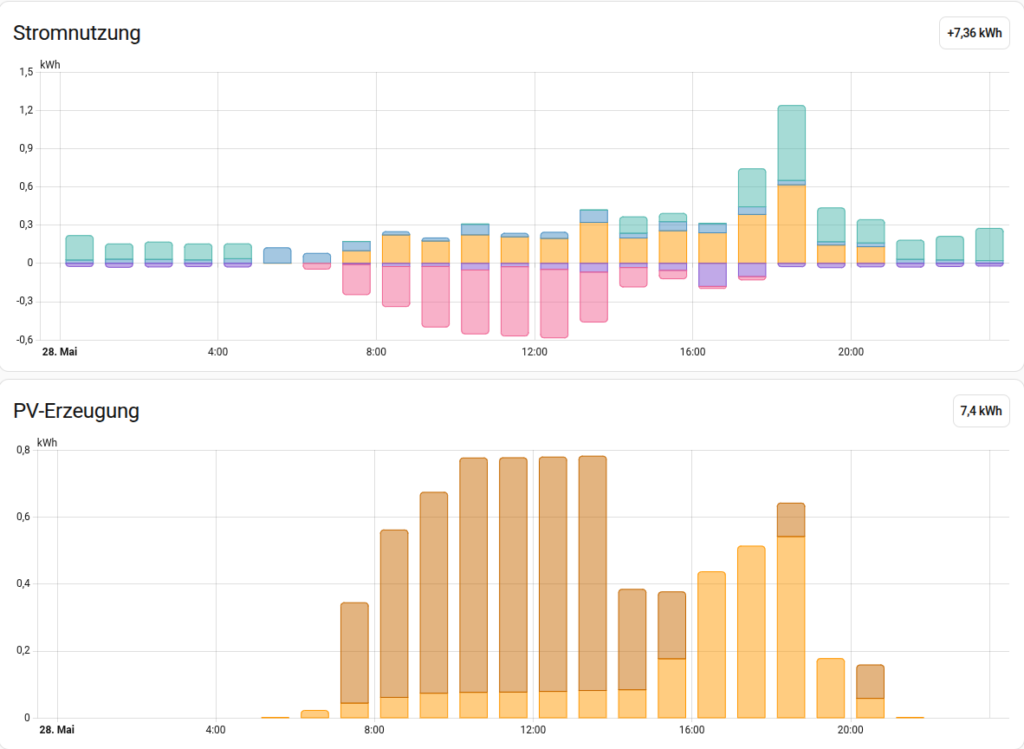
While solar modules usually reach their peak output between late morning and early afternoon, the majority of household electricity consumption only begins in the evening. The problem is not washing machines, dishwashers or ovens. The problem is us. After all, we are the ones shaping the load profile.
Optimizing the Load Profile
The good news is that the first stage of optimization is neither complicated nor expensive. Before diving into battery storage, home automation or other technical toys, it is worth taking a closer look at one’s own habits.
For example, the desire to mentally tick a task off the list does not necessarily mean that the corresponding appliance has to start immediately. Just because the washing machine has been loaded at 7 p.m. does not mean that it has to run between 7 p.m. and 11 p.m. In many cases, it is perfectly acceptable for the laundry to be finished sometime the next day. Shifting the cycle to the middle of the day not only saves money but is also likely to be appreciated by the neighbors in many apartment buildings.
The same applies to the dishwasher. Just because dinner is over and the dishes have been loaded does not automatically mean that the machine has to start immediately. In many households, there will be additional dishes after breakfast the next morning anyway. The real question is therefore not whether the dishwasher should run right away, but whether it could just as well do its job during the day.
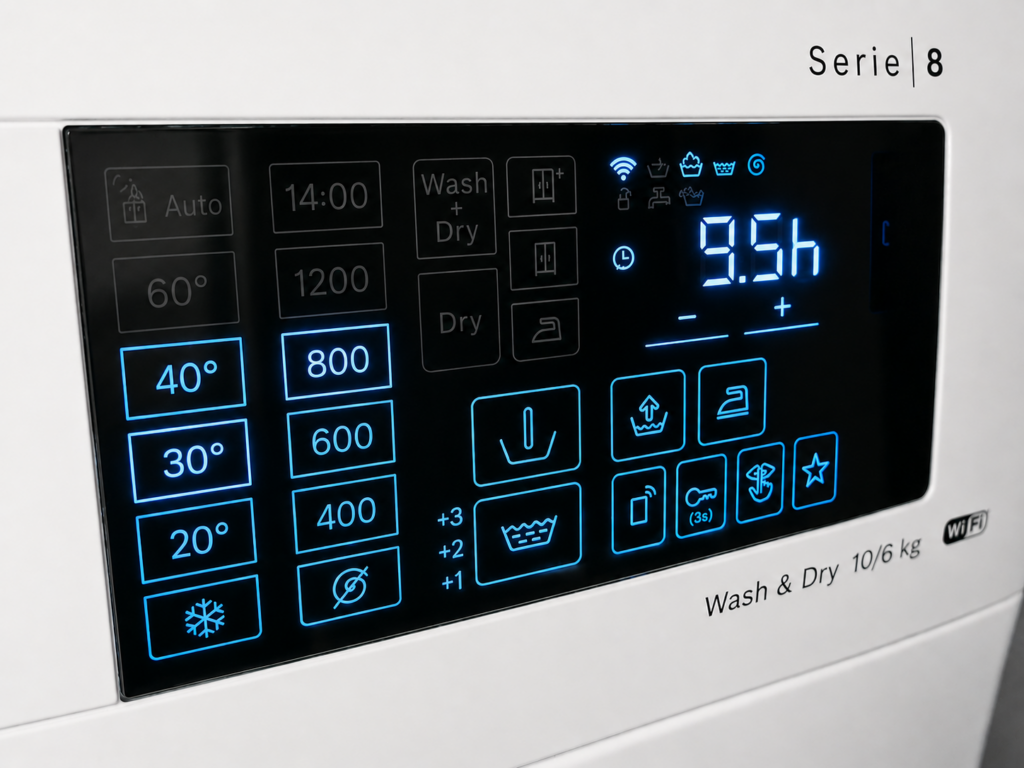
Surprisingly many modern appliances already come with the necessary functionality. Both washing machines and dishwashers often feature delayed start timers or similar functions. In my case, both appliances support this out of the box.
Anyone feeling particularly ambitious can even move on to the next level. Surprisingly, this does not involve artificial intelligence or home automation, but rather a bit of mental arithmetic. If the washing machine and the dishwasher are going to run during the day anyway, one might ask whether they really need to run simultaneously. Two appliances operating one after the other consume just as much energy, but spread that consumption over a longer period of time. This increases self-consumption and reduces electricity drawn from the grid without requiring the purchase of any additional equipment.
And should a little mathematics be required, the good news is that it remains pleasantly simple. Anyone capable of calculating that the washing machine needs three hours and the dishwasher two has already mastered the essential prerequisites.
Even these small changes in everyday habits can have a surprisingly large impact on self-consumption. And the best part is: they do not cost a single cent.
Limits of Optimization
Of course, not every load can be shifted around at will. At some point, the concept reaches its limits. After all, the goal of a balcony solar system is not to achieve complete energy independence, but to reduce the amount of electricity drawn from the grid. And that also means accepting that not every appliance can be powered entirely by solar energy.
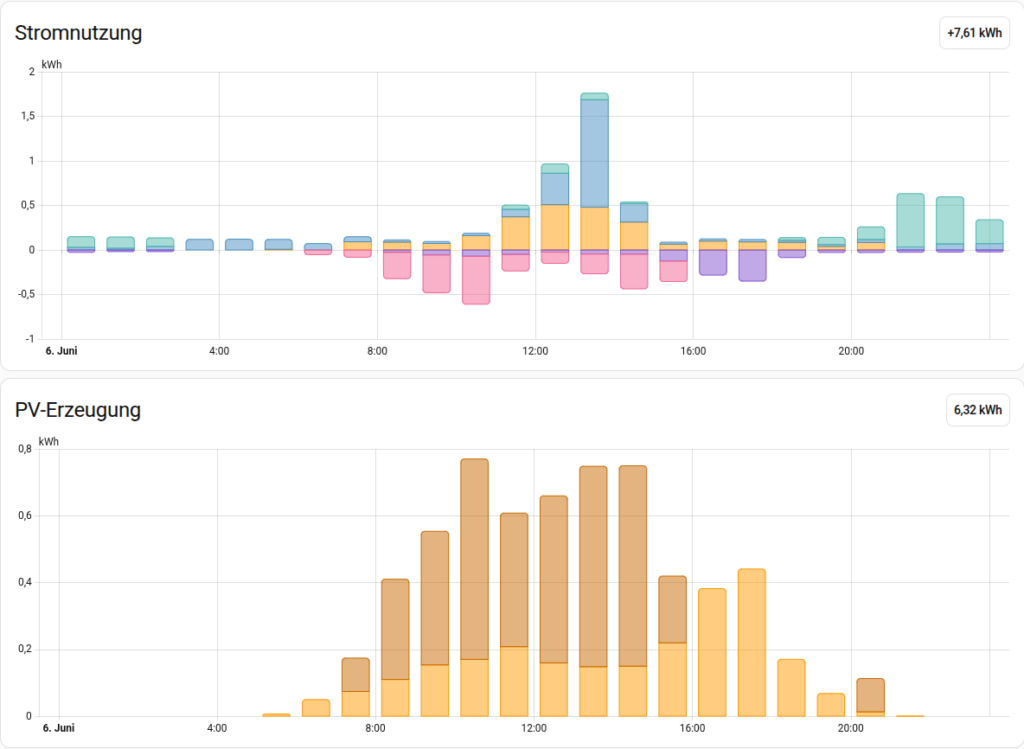
The three kilowatts of an oven, the 2.5 kilowatts of a coffee machine or the two kilowatts of a hair dryer can only be partially offset by a balcony solar system. Due to regulatory limits, no more than 800 W are available. And that is perfectly fine. Even if the solar system provides only a quarter of the power required while making coffee, it still reduces the amount of electricity drawn from the grid by one quarter at that very moment. And that saves money.
Perfection is not the goal.
Looking Ahead: Storage
There are, however, some unexpected consumers that lend themselves surprisingly well to optimization. Air conditioning systems, for example, are among the few devices whose preferred operating window aligns remarkably well with that of solar modules. After all, hot summer days and high solar yields tend to occur at the same time.
Things become even more interesting when one starts thinking of the apartment itself as a kind of thermal storage. If there is still excess solar power available in the afternoon, there is little reason not to cool the rooms a bit further. The resulting “coolness” remains available hours later.
At this point, however, we are already entering the realm of energy storage, control systems and even air conditioning. As for the latter, I am currently still waiting for a combination of quotations, delivery times and suitable technology to finally reach a conclusion — although at least the co-owners’ association has already approved the idea. Should this project eventually materialize, it will most likely deserve an article of its own.
Until then, it is enough to realize that a surprisingly large share of self-generated electricity can already be put to good use with surprisingly little effort.

You May Also Like

The Importance of Error Handling, Quality Control, and Documentation from the Perspective of an IT Operations Team

Home Automation Without the Cloud